5K Run/Walk to Support Financial Literacy

Exciting news! We are thrilled to announce the launch of our in-person 5k Run in Dallas to support financial literacy!!

We believe that financial education is crucial in today’s world, and we’re committed to making a difference. We couldn’t have done it without the support of our amazing sponsors. A big thank you to all of you for helping us make this event possible.

We can’t wait to see you all at the starting line on April 22nd! Lace up your running shoes and get ready to make a difference. Together, we can help promote financial literacy and make a positive impact in our community. #5kforfinancialliteracy #supportlocalschools #financialliteracyforall #thankyoutooursponsors
#missionsakshamyouth

All things Budget!

Budgeting is the most important and foundational financial topic when it comes to personal finances. Budgeting is basically how you will spend your money and prioritize where to spend it. It’s important to plan ahead of time so when time comes, you know your budget and can handle money better!

Let’s say you recently got a pay day. Everything is going just great and you suddenly remembered that you have to spend that money on your basic monthly expenses! Worst of all, you don’t have a budget plan. But don’t worry, it’s really easy to make one! First off, calculate your monthly income. Then try the 50/30/20 rule as a simple budgeting framework. This rule is used by many others, and known to work the best. Allow yourself to spend up to 50 percent of your income for your needs, like groceries or your bills. Leave 30 percent of your paycheck for your wants, like eat outs or any extra shopping. And lastly, commit at least 20 percent of your income for savings or any debt repayment.

There are so many different ways to make a budget plan, from using various budgeting apps or even as simple as the 50/30/20 rule! It’s important to know how much you spend and set limits. Therefore, it’s essential to always know your budgets

What is a stock?

You may have heard of the word stock in the news or in casual conversation but what exactly is a stock? A stock, also known as equity, is a unit of ownership in a company. When someone purchases a stock in a company, they become a shareholder and the small piece they own is called a share. People buy stocks in hopes that the business will succeed so when the company does well, its stock owners share in those profits. Investors can buy stocks by opening an account with a stockbroker. To diversify where investors invest their money, they can invest in something called stock funds. An example of a stock fund is the S&P 500.

There are two ways an investor can make returns on their investment: capital gains and dividends. Capital gain is the profit you make when you sell your stock at a greater value than what you had purchased it for. Dividends are regular payments to shareholders. Each company can set its own dividend schedule but a quarterly payout is the most common. This is why dividend stocks are most attractive to people who are nearing retirement or who already are in retirement.

What are some types of stocks? To break it down there are common stocks and preferred stocks. Common stocks, as said in the name, are the most common stocks for shareholders to own. They typically receive quarterly dividends and voting rights however these dividends fluctuate and are not guaranteed. Preferred stocks, on the other hand, pay a higher fixed dividend than what common stock would pay but their share prices don’t appreciate as much as common stock do. The preferred stock gets paid its dividend before the common stock even in the event of bankruptcy.

Stocks are a great way to invest your money to further grow your capital as it allows you to invest at your own risk and comfort.

Insurance and why is it important?

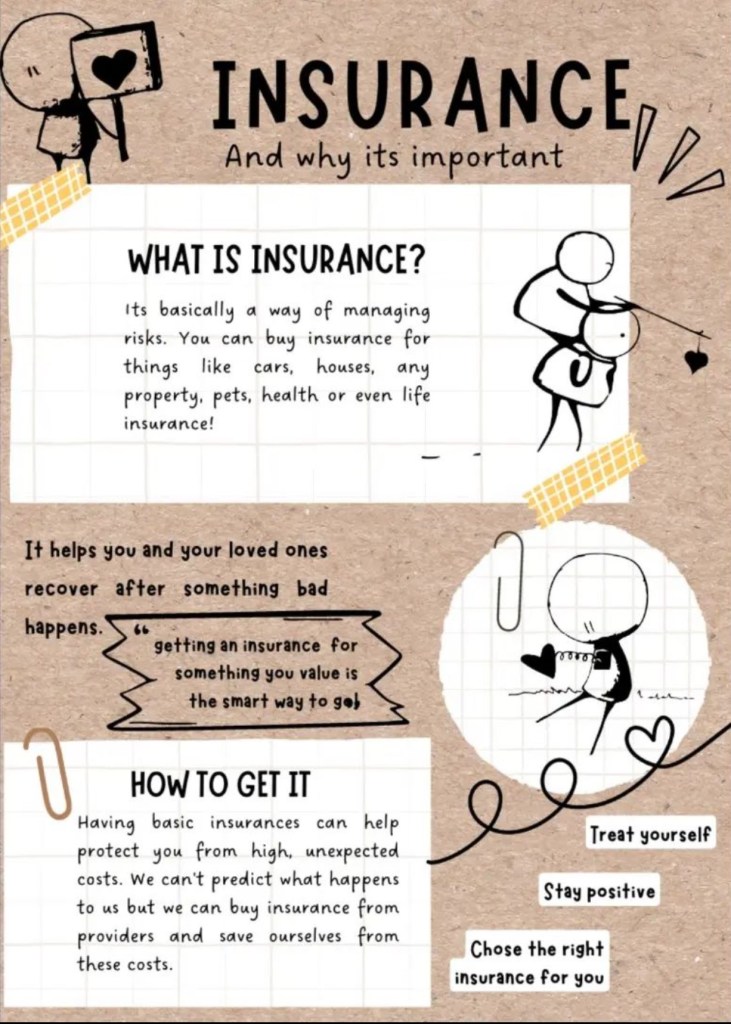
Insurance is basically a way of managing risks. You can buy insurance for things like cars, houses, any property, pets, health or even life insurance! It helps you and your loved ones recover after something bad happens, such as fire, theft, or a car accident.

Let’s just say that someone had a car accident and their car got damaged. If they have car insurance, they won’t have to pay the entire cost for the damages, since a part of it is covered by their insurance company. The amount of money that will be covered depends on the insurance provider.

Having basic insurances can help protect you from high, unexpected costs. We can’t predict what happens to us but we can buy insurance and save ourselves from these costs.

Planning For College

Before I became an educator, I worked for a university in the Financial Aid department. For many, Financial Aid was a scary territory, because it was the department that worked directly with Student Loans. The first tip when planning for college that I would suggest, would be to avoid student loans as much as you can. I know everyone is different and comes from different backgrounds. The best tips I would suggest would be to start thinking and planning now! College is expensive and you will thank your past self for planning early. Start with listing out schools you would like to attend! Remember, just because the school has a well-known name, does not promise you higher success than attending a state school. You can save thousands of dollars by considering attending a state university. Even better, you could save even more money by starting out at a community college. In most cases community college tuition costs are significantly lower than average 4-year colleges.

Make sure you have done your research, and you are fully aware of the cost of school.

My second tip would be to consider taking dual-credit classes in high school. By taking dual credit, you have the possibility to save money on the class expenses and get ahead in your plan of study.

SCHOLARSHIPS! Do not skip out on applying for scholarships. They are everywhere! Research online all the different types of scholarships you can apply for. Don’t just for the big ones, because there are MANY lower amount scholarships that are just as useful as one large scholarship. The best thing you can do for yourself is approach applying for scholarships as a part-time job, sit down a few hours a day, and research and apply to all that you can find. I would even recommend applying for scholarships that you may not 100% meet the requirements, but perhaps at least 75% of the requirements, because in some cases, you may be selected if not enough people applied for it.

Teen Investing

Why is it important to invest as a teen? Are teenagers too young to step into stocks? How can a teen SAFELY invest at such an age?

Teenage is one of the critical points in one’s life. During the teenage years, lots of exciting things happen in life like getting your first job and earning money; this is the perfect time to learn about the importance of saving, investing, and the best ways to do so. If teens are not aware of benefits of saving and investing, their spending might lead them down the wrong path.

As teenagers gradate high school and start applying to colleges, one of the obstacles in this journey might be the tuition of colleges. Even though colleges offer financial aid, not everyone who needs it fits into the requirements for aid. It is very unfair for a student to not be able to attend the college he/she wants due to their financial condition. Let’s say the student manages to attend the college by taking a loan. This creates problems for the future because these students spend the next 10-12 years after college, paying their student debt. These situations can simply be avoided if a teen had invested and saved money leading up to or in college.

Many of the parents think that teaching their children about finances has to be complicated, but Massey, Professor of Sociology and Public affairs at Princeton, says “if parents take the time to help teens understand the difference between wants and needs, they’ll learn to save, budget, and invest”. Teens can start their journey by exploring Stock Market Stimulators, and then shift into the real stock market. They can also save larger portions of their income, high yield savings, and cut down on unnecessary spending. Small things like these add up and make a big difference, which benefits teens in the long run and helps them have a financially secured future.

What is and how does insurance work?

Insurance is one of the largest expenses individuals have regularly, coming in at hundreds, if not thousands of dollars a month for each person. Such high costs warrants that most individuals, especially teens, should understand what insurance is and how it works before they start taking on that expense. Although the math behind insurance payment calculations is complicated, insurance policies have the same fundamentals.

Let’s start with the basics: What is insurance?

Insurance is a way to limit your financial liability through potential times of loss. In Layman’s terms, you are paying someone a bit of money every month now, and in return, they will give the money back when you need it most. Essential terms and parts of insurance everyone should know:

1. Premium: Premium is the monthly payment made for an insurance policy. Premium amount will differ based on many factors, from the type of insurance to how reckless the applicant has been in the past.

2. Deductible: Deductibles are the amount of money you must pay out of pocket before filing a claim with the issuance company to cover damages or loss.

3. Policy limit: The policy limit is the most amount of money an insurance company will pay for damages, based on your selected policy. There can be multiple sub-components of this based on the kind of insurance you have.

4. Copay: Copay is a fixed amount the policy holder has to pay whenever they get a service that is covered by insurance. Copay only kicks in after the entire deductible amount has been paid and is mainly available in health insurance.

5. Exclusions: Exclusions are parts of services or scenarios that are not covered by your insurance, despite it seeming that they should be.

6. Riders: Riders are optional add-ons to an insurance policy. Although these will increase your monthly premiums, the increase can be your worth it

It is important to understand that each of the elements of insurance given above will vary based on your lifestyle and risk appetite, the insurance company, and even other elements listed above. The math behind the pricing can get quite complex but the basics of insurance aren’t, and it always pays off to be aware before having to handle it all by yourself.

The Time Value of Money

My friend needs $1000 right now, I tell him, “I’ll give you $1000 if you give me $1100 next year”. This is the idea behind a loan or a credit card. It sounds like a bad deal, but according to the time value of money it makes sense. An amount of money right now is worth more than the same amount of money in the future. So, if I have $1000, in a year it is worth $1100. This is bad for the people who need money immediately, in order to get money immediately, they have to pay more money in the future. 

The time value of money teaches us that you want to have money available. Never spend more money than you make. If you spend more money than you make, then you end up needing money immediately and your only choice becomes using a credit card or taking out a loan. 

If you have money now, it has the potential to be more money in the future. If you spend money as soon as you get it, you end up needing money and paying $1100 for $1000. Loans disguise themselves as easy to pay off by requiring monthly payments, but in the long run you end up paying much more than you received in the first place.

Know your limit. Know how much money you can spend and keep extra just in case, because money is more valuable right now than it will be in the future.

Student Loans

We all know that many students that are stepping into college consider and look to student loans for financial support for their academic career ahead. But when it comes to repayment of these student loans, the debt places a lot of pressure and stress on the undergraduate students. According to a study done by Student Loan Hero, “Almost three quarters (73%) of undergraduates with student loans are at least somewhat worried about their ability to repay debt”. (https://studentloanhero.com/).

There are several ways to reduce the pressure about repaying loans for students. Colleges can help students track their budget and help them understand their loans and what the owe. By getting to know how much the students have to pay back can really ease out the stress because everything becomes more organized. Students can try sticking to a budget, consider getting part time job(s) to make a few extra bucks. They can also look into developing a plan to help their financial health. With all due respect, everyone has their own opinions on how students should handle their student loans, but these are just some of my ideas.